
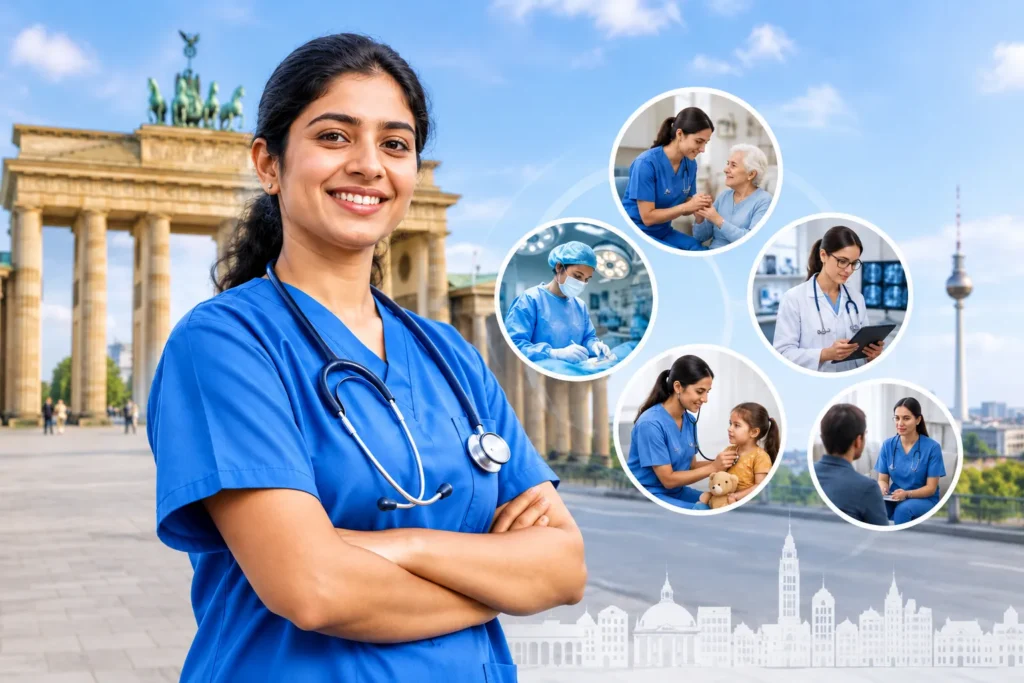
Getting recognised as a nurse in Germany is a big milestone, but it is rarely the end of the story. After some time on the ward, most nurses start asking a different question: where do I want my career to go next? Germany’s hospitals, care homes, and home care services all need nurses with specialist skills, and for many Indian nurses, nursing specialisations in Germany are how a first job turns into a long-term career.
This guide covers the specialisations employers look for, how specialist training works, and what to plan for along the way.
Nursing Specialisations in Germany: What Indian Nurses Should Know
Since 2020, nurses in Germany train in one generalist programme that covers general, paediatric, and geriatric care. Specialisation comes afterwards, usually through formal further training known as Fachweiterbildung. The numbers show how much of the workforce this covers: according to the Federal Employment Agency’s report, Arbeitsmarktsituation in Pflegeberufen, 122,000 nurses worked as specialists, such as in intensive care and anaesthesia, or in leadership roles. That is about 7% of the nursing workforce.
All of this sits on top of a wider shortage. The same agency reports only 57 unemployed qualified nurses for every 100 advertised vacancies, and the Federal Statistical Office (Destatis) projects a shortage of 280,000 to 690,000 nurses by 2049. That keeps nursing jobs in Germany open across many fields. One honest caveat: official statistics do not rank individual specialisations, so demand varies by region and employer.
Read to know more:
- Shortage of Nurses in Germany: Opportunities for Indian Nurses
- Essential Nursing Skills German Employers Look For
- Goethe vs telc vs ÖSD: Which Is the Best German Exam for Indian Nurses?
Top Nursing Specialisations in Germany
Once you have settled into your first role, you can choose a specialist path. Here are the main options and what each involves.
Intensive Care and Anaesthesia Nursing
The Federal Employment Agency itself names intensive care and anaesthesia as typical specialist roles. They suit nurses who like high-acuity work, close monitoring, and quick decisions. These roles are typically found in hospitals, which employ 734,000 nurses, the largest share of the workforce.
Operating Theatre (OR) Nursing
OR nurses support surgical teams by preparing instruments and equipment and helping keep patients safe before, during, and after procedures. The work rewards precision and calm teamwork.
Emergency and Paediatric Nursing
Emergency nursing is about fast assessment and clear priorities, while paediatric nursing focuses on children and their families. Since the 2020 reform, paediatric care is part of the generalist training, and you can specialise further afterwards.
Dialysis and Nephrology Nursing
Dialysis nurses care for patients with kidney disease, often over the course of years. The role mixes technical skill with long-term patient relationships.
Geriatric and Palliative Care Nursing
Ageing is one of the biggest forces shaping demand. Destatis reports that about 5.7 million people needed care in December 2023, and 86% of them were cared for at home. The Federal Employment Agency adds that outpatient care grew faster than any other setting over ten years, by almost 50%. For nurses planning a nursing career in Germany, geriatric and palliative care offer steady nursing jobs in hospitals, care homes, and home care.
Wound Management and Psychiatric Nursing
Wound management nurses handle complex and chronic wounds, while psychiatric nurses support patients with mental health conditions. Both roles value patience, careful observation, and strong communication. Whichever specialisation you choose, German language for nurses matters at every step, from handovers to patient conversations.
Fachweiterbildung: How to Specialise as a Nurse in Germany
Many of these specialisations are formal, state-recognised programmes. For Indian nurses, the usual sequence is nursing recognition in Germany (Anerkennung), a period in a first role, and then specialist training. Requirements, duration, and funding differ by state and employer, so ask early whether your employer supports it. Support does exist: the Federal Employment Agency reports around 900 funded training starts in 2025 in specialist nursing, such as intensive care or long-term care.
Nurse Salary in Germany for Specialist Nurses
Specialist training can also move you up the pay scale. The Federal Employment Agency’s Entgeltatlas shows a median nurse salary in Germany of €4,587 gross per month for registered nurses. The agency also reports that nurses in hospitals earned a median of €4,409 in 2024, above the €4,275 average for all qualified nurses.
Under the public-sector TVöD, the grading rules place nurses with completed specialist training and a matching role in pay group P9. In the table published by Haufe for May 2026 to March 2027, that group ranges from €3,992 to €4,662 per month. Actual pay depends on your employer, experience step, and allowances.
German Language for Nurses: Why It Matters for Every Specialisation
Specialist work runs on fast, accurate communication: emergency handovers, theatre briefings, and sensitive conversations with patients and relatives. That makes German language for nurses central to every specialisation, not just a requirement for the first job. The Bavarian State Office for Care, for example, requires a B2 certificate before it issues the licence to use the nursing title, and specialist employers may expect confident German beyond that.
A nursing career in Germany can begin in a general role and grow into a specialisation. Recognition and language come first, then experience, then specialist training in the area that suits you best. Demand is strong across intensive care, theatre, emergency, paediatric, dialysis, geriatric, palliative, wound, and psychiatric nursing, although it varies by region and employer. Choose a path that matches your interests, ask employers about training support, and start your language learning early.
Build Your Nursing Career in Germany with Raahi Global
A specialisation starts with a strong foundation. Raahi Global supports Indian nurses with profile evaluation and career counselling, German language training (A1 to B2), document verification, employer matching, interview preparation, and visa and licensing support, so every step toward recognition is planned. After arrival, relocation assistance and post-landing support guide nurses through their first weeks.
Ready to plan your specialist path? Speak with a Raahi Global counsellor and start building your nursing career in Germany.