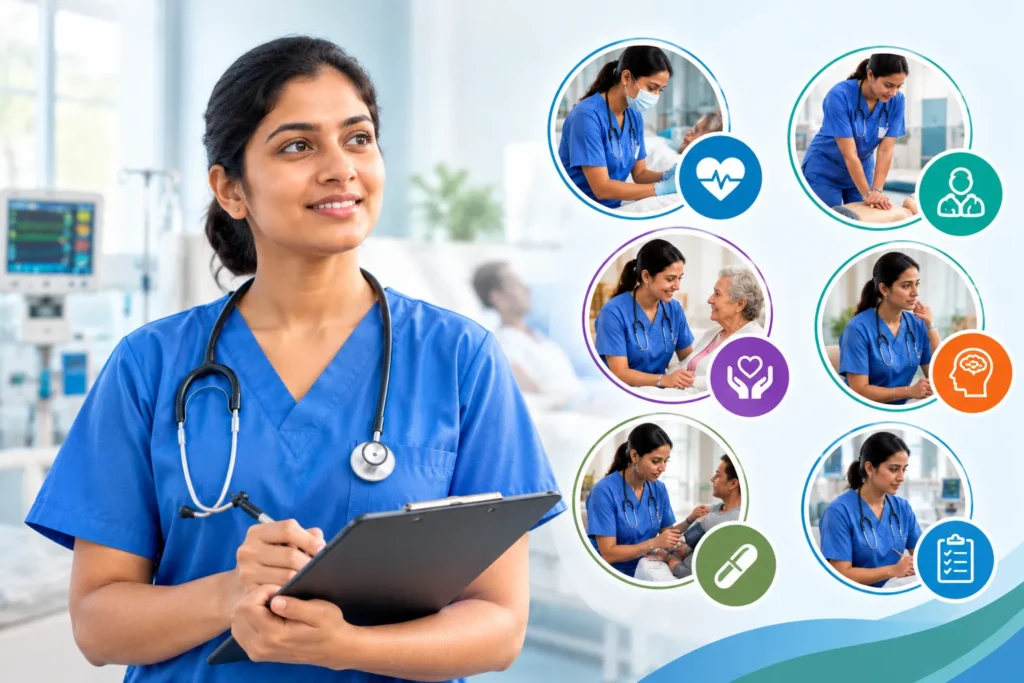
Nursing skills go well beyond clinical procedures. The best nurses combine communication, judgment, technical ability and compassion. With many health systems short of staff, these essential nursing skills also decide who gets hired and who builds a strong, lasting career.
This guide covers the nursing skills employers value most and why demand for skilled nurses remains high.
Why Are Nursing Skills in Higher Demand Than Ever?
Even as the global nursing shortage narrows, it remains large. According to the WHO and the International Council of Nurses, the world was short of 5.8 million nurses in 2023, down from 6.2 million in 2020, with a projected gap of 4.1 million by 2030. The WHO’s State of the World’s Nursing 2025 report also found that one in seven nurses worldwide works in a country other than where they were born, rising to 23 percent in high-income countries.
Government projections point the same way. The US Health Resources and Services Administration (HRSA) projects an 8 percent shortage of registered nurses in 2028. The US Bureau of Labor Statistics (BLS) projects RN employment to grow 6 percent from 2025 to 2035, with about 180,800 openings each year. Employers look for nurses who bring both clinical competence and strong people skills.
Which Nursing Skills Do Employers Look For Most?
Employers look for a mix of clinical and interpersonal strengths. These are the core nursing skills that matter most, starting with communication.
Communication Skills in Nursing
Effective nurse communication skills are central to patient safety and satisfaction. Nurses talk daily with patients, families and colleagues, so they need three abilities:
- Verbal clarity: explaining diagnoses and treatment plans in simple language, then checking understanding.
- Non-verbal awareness: eye contact, tone and a reassuring presence all shape the patient experience.
- Active listening: giving full attention and acknowledging concerns builds trust.
Communication also includes language proficiency, which is often a licensing requirement for nurses working outside their home country.
Critical Thinking and Problem-Solving
Critical thinking in nursing means assessing a situation, weighing evidence and acting quickly. Nurses who notice subtle changes in vital signs can prevent complications before they become emergencies. They also collaborate on decisions and adapt when protocols or patient conditions change. Strong problem-solving skills for nurses show most clearly under pressure, when several patients need attention at once.
Technical and Clinical Skills
Employers expect solid competence in core clinical nursing skills, including:
- Medication administration and wound care
- Monitoring vital signs
- Responding to emergencies, including CPR and airway management
- Using electronic health records (EHRs), medical devices and telehealth platforms
- Regular training and simulation keep these technical nursing skills sharp under pressure.
Empathy and Cultural Competence
Empathy in nursing improves patient experience and recovery. Cultural competence matters even more for internationally educated nurses, because patients’ backgrounds shape their health beliefs and expectations. Nurses who adapt their care to the individual build trust faster and reduce misunderstandings, which supports safer, more person-centred care.
Time Management and Organisation
Nursing is fast-paced, so strong time management skills for nurses are essential. Good nurses prioritise urgent needs, juggle several responsibilities and keep accurate, organised records. Clear documentation ensures continuity of care and protects both patient and nurse. The same discipline helps with paperwork such as licensing and qualification recognition.
Teamwork and Collaboration
Teamwork in nursing is essential, because nurses work alongside doctors, therapists, dietitians and other specialists every day. Knowing each person’s role, resolving conflict constructively and supporting colleagues all lead to better patient outcomes. Strong collaboration skills for nurses also make handovers smoother and reduce errors.
Continuous Learning and Professional Development
Healthcare evolves constantly, so continuous learning in nursing is a skill in its own right. Nurses who stay current through workshops, further study, peer feedback and mentorship progress faster in their nursing career development. Employers see this habit as a sign of long-term commitment.
Strong nursing skills are what turn a qualified nurse into a trusted one. Clear communication, sharp critical thinking, technical competence, empathy, good time management, teamwork and continuous learning work together to improve patient outcomes and open doors in your career. With the WHO projecting a global shortage of 4.1 million nurses by 2030, employers will keep placing a premium on nurses who bring these skills to every shift. Treat each skill as something you can keep developing, and your value to patients, colleagues and employers will keep growing.
Turn Your Nursing Skills into an International Career with Raahi Global
Taking those skills abroad takes more than clinical ability, it takes the right preparation. Raahi Global supports Indian nurses through its German Healthcare Nursing Program, starting with profile evaluation and career counselling. From there, candidates receive German language training up to B2, credential verification, interview preparation, employer matching, visa support and relocation help. Communication, teamwork and cultural competence matter most in a new country, and Raahi Global helps you build them. Visit raahiglobal.com to start your journey.