
Raahi Global Insights

Indian nurse arriving in Germany and receiving a warm welcome, with airport arrivals signage, German landmarks, and support service icons.

Why Post-Landing Support Matters for Indian Nurses Settling in Germany

Landing in Frankfurt or Munich with a visa, a job offer and a suitcase feels like the finish line. For most Indian nurses in Germany, it is only the start. A nursing career in Germany can change your life, but the first 90 days after arrival often decide whether it works out. That is why post-landing support for Indian nurses in Germany is one of the most underrated parts of the whole journey. Why Germany Needs Indian Nurses Germany’s demand for healthcare workers is not a passing trend. The Federal Statistical Office (Destatis) projects that the country will need 2.15 million nursing professionals by 2049, and that the shortfall could reach 280,000 to 690,000 nurses, depending on how demographics and recruitment develop. Germany is also becoming more open to foreign talent. In 2024, a record 32,500 foreign nursing professionals had their qualifications recognised, 19% more than the previous year. If you’re exploring nursing jobs in Germany, the opportunity is real. The risk lies in what happens after you arrive. Read these articles to know more: What Indian Nurses Face in the First Weeks After Arriving in Germany Most recruitment conversations focus on the visa, the contract and the pay. Few describe the first week in a new country, when you’re jet-lagged and trying to make sense of a bureaucracy that runs on appointments and paperwork. Here is what typically lands on a new nurse’s plate within the first few weeks: That payslip alone catches many people off guard. According to PayScale, the average nurse salary in Germany is about €37,143 per year in base pay, but what reaches your account is lower after tax, pension, health and nursing care insurance. Nurses who don’t understand these deductions often misjudge their budget in the first months. Each task is manageable on its own. Together, in a language you’re still learning, they can overwhelm even the most capable nurse. German Language for Nurses: The Skill That Keeps Growing Most Indian nurses arrive with a B1 or B2 certificate in hand. Passing the exam, however, is not the same as understanding a doctor’s rapid handover, a patient’s dialect or a colleague’s slang. German language for nurses is a different skill from classroom German. You need medical terminology, documentation vocabulary and the ability to reassure an elderly patient in simple, warm phrases. Nurses who keep learning after they land settle faster, earn more trust from their teams and move into senior roles sooner. Without ongoing help, many nurses get stuck at a level where they can work but can’t grow. A refresher course, a language buddy or guided preparation for the professional language exam (Fachsprachprüfung) can change that. Why Post-Landing Support Matters for Indian Nurses Pre-departure preparation gets you to Germany. Post-landing support for Indian nurses in Germany is what helps you stay, grow and succeed there. Here is why it matters so much. In short, strong relocation support for nurses turns one of the many nursing jobs in Germany into a lasting nursing career in Germany. What Strong Post-Landing Support Looks Like When you evaluate a recruitment or relocation partner, look beyond the job offer. Strong post-landing support for Indian nurses in Germany usually includes: If a partner disappears after you land, treat that as a warning sign. Settling In Is What Makes the Move Worth It Getting a nursing job in Germany is an achievement. Staying, thriving, and building a stable life there is the real goal. The nurses who succeed are not always the most qualified. They are often the ones who had the right support at the right time: someone to explain the system, steady their nerves, and help them find their feet. A nurse’s journey does not end when the flight lands. Raahi Global supports Indian nurses through the full German Healthcare Nursing Program: profile evaluation and career counselling, German language training (A1–B2) with Goethe exam preparation, document verification, employer matching, interview preparation, and visa and licensing support. After arrival, relocation assistance and post-landing support cover accommodation guidance, local registration (Anmeldung), banking, and cultural integration, so the first weeks feel manageable. Ready to build your nursing career in Germany with a partner who stays beyond landing? Book a free eligibility check with Raahi Global and take the first step.

Why Post-Landing Support Matters for Indian Nurses Settling in Germany Read More »

Indian nurse receiving career counselling to plan her nursing career in Germany

How Career Counselling and Profile Evaluation Help Indian Nurses Choose the Right Path to Germany

Searching for nursing jobs in Germany brings up a confusing mix of agency promises, forum posts, and conflicting advice. The opportunity itself is real. The Federal Statistical Office (Destatis) projects a shortage of 280,000 to 690,000 nurses by 2049, and Indian nurses are already part of the answer: India was among the top five countries of origin for recognised foreign qualifications in 2025, with about 5,400 recognitions across all professions. Demand alone, though, does not tell you which route suits your own background. That is where career counselling and a proper profile evaluation make the difference. Why Indian Nurses Need Career Counselling Before Moving to Germany A nursing career in Germany is not one single path, and Indian nurses start from very different places. Some hold a GNM diploma, others a B.Sc. Nursing or Post Basic B.Sc. Nursing degree, and these differ in length and content, so German authorities may assess them differently. Add your specialty, years of experience, and the state where you want to work, and two nurses from the same Indian city can end up on very different timelines. Good career counselling turns scattered information into a clear plan. It answers practical questions early: Is your qualification likely to be assessed as equivalent? How much German language for nurses will you need before you can apply? Which employers recruit international nurses? It also sets realistic expectations about pay. The nurse salary in Germany has a median of €4,587 gross per month for registered nurses, but that figure describes recognised, qualified nurses, and pay before recognition may be lower. Read these articles to know more: What Does a Nursing Profile Evaluation Involve? A profile evaluation is a structured review of where you stand today. For Indian nurses, it usually looks at: The result is a realistic picture of your strengths and gaps. It also shows which documents need attention first, which matters because recognition authorities review your training content, duration, and experience before deciding on nursing recognition in Germany. Choosing the Right Pathway: Recognition First or a Recognition Partnership? There is more than one way for Indian nurses to reach recognition, and the best choice depends on the profile. Outcomes can also differ. If authorities find differences between your Indian training and German standards, you may be asked to take a knowledge test or an adaptation course. Recognition is handled by the authority in the state where you plan to work, so your target state matters too. This is worth planning for, because the Federal Employment Agency’s May 2026 report, Arbeitsmarktsituation in Pflegeberufen, shows that 64% of nurses from Triple Win countries, which include India, work as qualified nurses, while among foreign nurses overall only about half do. Key Benefits of Career Counselling and Profile Evaluation for Indian Nurses A good profile evaluation does more than organise your paperwork. It gives Indian nurses practical advantages from day one: Start With an Honest Profile Evaluation Germany needs nurses, but it also needs them to arrive prepared. A clear profile evaluation, honest career counselling, and a route matched to your situation give Indian nurses the strongest start, and they replace guesswork with a plan you can follow step by step. Raahi Global helps Indian nurses take that first step with a free eligibility check and one-on-one career counselling, followed by German language training (A1–B2), document verification, employer matching, visa assistance, and post-landing support. Whether you are exploring nursing jobs in Germany or ready to build your nursing career in Germany, talk to a Raahi Global counsellor to see which path fits your profile.

How Career Counselling and Profile Evaluation Help Indian Nurses Choose the Right Path to Germany Read More »

Indian nurse reviewing documents for nursing recognition in Germany, with qualification folders and German landmarks in the background.

Documents Required for Nursing Recognition in Germany: A Checklist for Indian Nurses

Getting your paperwork right is the first real hurdle on the way to nursing jobs in Germany and a lasting nursing career in Germany. The effort pays off: German authorities approved about 86,600 foreign qualifications in 2025, and nursing was the most frequently recognised profession, with 32,000 approvals, according to Destatis. India was among the top five countries of origin, with about 5,400 recognitions across all professions. This guide walks through the documents required for nursing recognition in Germany so your application starts on solid ground. Why Nursing Recognition in Germany Matters Nursing is a regulated profession in Germany. To work as a nurse, you need a state licence, which lets you use the title Pflegefachperson, Pflegefachfrau, or Pflegefachmann, as explained on the Bremen service portal. Without Anerkennung (recognition), you cannot practise as a registered nurse, no matter how much experience you have. Recognition also shapes your pay. The nurse salary in Germany follows your qualification and role, and the Federal Employment Agency’s Entgeltatlas shows a median of €4,587 gross per month for registered nurses. The competent authority in your target state decides whether your training is equivalent to German nursing training, and it can only judge what it can see. That is why complete, well-organised documents matter. Refer to these articles: Documents Required for Nursing Recognition in Germany: The Core Checklist Exact lists vary by state, and the responsible office will tell you what it needs. The federal Recognition in Germany portal and state portals generally ask for the following: Note: Each of these documents needs a German translation. Personal and Health Suitability Documents Authorities also need proof that you are fit and reliable to work as a nurse. This usually means: Timing matters here. The federal portal states that the certificate of good conduct must be no more than 3 months old when the application is submitted, and the Hessian administrative portal applies the same limit to the medical certificate. Bremen notes that these documents are usually handed in later, when the office asks for them. Order them last, once the rest of your file is ready, so they do not expire while you wait. German Language for Nurses: The B2 Certificate You Need German language for nurses is a core part of the recognition procedure. The Bavarian State Office for Care, for example, requires a B2 certificate before it issues the licence to use the nursing title. Berlin accepts B2 certificates from Goethe-Institut, telc, TestDaF, or ECL-certified schools, and notes that the certificate should be no older than 3 years and need not be submitted at the time of application. Validity rules differ by authority, and some states may also require a separate professional language exam (Fachsprachprüfung). Confirm both points before you book your exam, so you do not need a second certificate later. Certified Translations and Copies This is where many applications slow down. The federal portal states that every document needs a German translation, and authorities typically expect a sworn or certified translator. Some offices accept a simple translation for certain documents, so ask first. Copies follow a similar rule. According to Bremen, the office will tell you whether it wants a simple copy, a certified copy, or the original for each document, and in Hessen, certified copies are requested at a later stage. Do not post original certificates unless the authority specifically asks for them. Common Mistakes That Delay Nursing Recognition A few avoidable errors cause most of the delays: Can Indian Nurses Apply From India? Often, yes. The federal portal lists a recognition partnership route that allows you to enter Germany and complete recognition there. Conditions include at least two years of training or a degree, confirmation from the Central Office for Foreign Education (ZAB) that your qualification is recognised in the country of training, A2 German at minimum, and a German employer. Check whether this route fits your situation before relying on it. A strong application is rarely about one perfect document. It comes from a complete, consistent, and correctly translated set of papers that the authority can review without back-and-forth. Start with your nursing degree, transcripts, and experience letters, plan your language certificate around your timeline, and collect time-sensitive documents last. Careful preparation here sets up the rest of your nursing career in Germany. Because requirements vary by state and change over time, always verify the current checklist with the competent authority before you submit. Gathering, translating, and certifying documents can feel overwhelming, especially alongside work and language study. Raahi Global supports Indian nurses with a free eligibility check, document verification, and German language training (A1–B2), then guides them through visa assistance, employer matching, and post-landing support. With a clear checklist and expert guidance, you can approach nursing recognition in Germany with confidence. Talk to a Raahi Global counsellor today!

Documents Required for Nursing Recognition in Germany: A Checklist for Indian Nurses Read More »

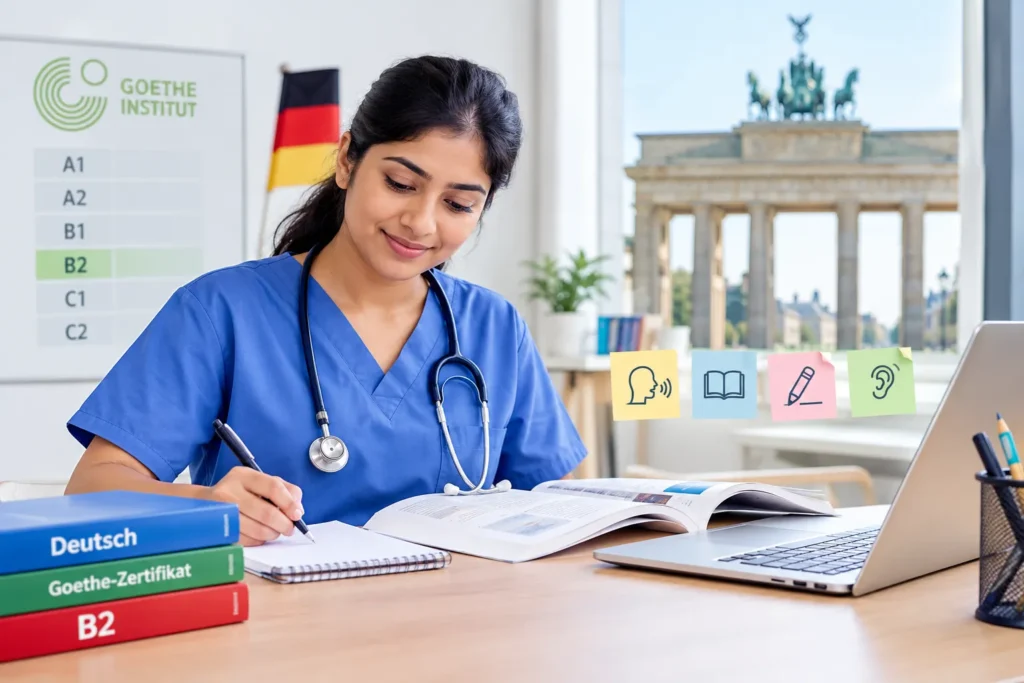
Indian nurse preparing for the Goethe B2 German language exam with study materials, textbooks, and a laptop in a German learning environment.

Goethe Exam for Nurses: B2 Format, Levels and Tips

For many Indian nurses, German is the biggest hurdle on the road to nursing jobs in Germany. The standard proof of language skill is a B2 German certificate, and the Goethe exam for nurses is one of the most trusted ways to get it. This guide covers the German language requirement for nurses, the German language levels, the Goethe B2 exam format, the nursing-specific Goethe-Test PRO Pflege and practical preparation tips, using information from the Goethe-Institut, Make it in Germany and German state nursing authorities. Why Nurses Need B2 German: The German Language Requirement for Nurses Nursing is a regulated profession, so your qualification must go through Anerkennung (recognition) before you can work as a Pflegefachperson. According to Make it in Germany, the federal government’s portal for skilled workers, nursing recognition in Germany requires at least level B2 of the Common European Framework of Reference for Languages (CEFR). Many nurses go through this process. The Federal Institute for Vocational Training (BIBB) recorded about 22,400 recognition applications from nurses in 2024, more than any other profession, and about 3,900 applications from India overall. The Bavarian State Office for Nursing states that applicants must present a B2 certificate before receiving the permit to use the professional title. German Language Levels (CEFR) for Nurses: From A1 to B2 The CEFR has six German language levels, from A1 (beginner) to C2 (near-native). At B2, you can follow the main ideas of complex texts, including specialised discussion in your field, and interact fluently with native speakers. That is the level needed to read care documentation, talk with patients and hand over to colleagues. Most Indian nurses start at A1 or A2 and work through B1 to B2. The Goethe-Institut estimates that reaching B2 takes 600 to 800 teaching units of 45 minutes, depending on your prior knowledge and learning conditions. Many nurses join a structured German language course for nurses to cover this ground efficiently. Starting early and leaving buffer time before your exam date protects your recognition timeline. Read these articles to know more: Goethe-Zertifikat B2 vs Goethe-Test PRO Pflege Two Goethe exams are relevant to nurses: State authorities decide which language certificates they accept. Bavaria and Hesse both list the Goethe-Zertifikat B2 and Goethe-Test PRO Pflege, along with alternatives such as telc Deutsch B2 Pflege and ÖSD B2. Lists differ by state and change over time, so confirm with your authority before booking. Note that the Goethe-Institut says the PRO Pflege exam is booked for groups, with date and time arranged in advance, for example through an employer or recruitment partner. Individual candidates usually take the Goethe-Zertifikat B2. Goethe B2 Exam Format: Modules, Duration and Passing Score The Goethe-Zertifikat B2 has four modules: The exam takes about 195 minutes in total, and a module is passed with at least 60% of the points. At selected centres, it is offered digitally as well as on paper. Goethe-Test PRO Pflege Exam Format The Goethe-Test PRO Pflege is part-digital and covers listening, reading, writing and speaking: Because the tasks mirror daily ward work, nursing vocabulary matters as much as grammar. Goethe B2 Preparation Tips for Nurses Preparing for the Goethe B2 exam requires regular practice and a clear study plan. For Indian nurses, B2 German for nurses combines general language skills with nursing vocabulary to improve exam readiness and build confidence for working in Germany. Conclusion: Treat B2 German as Your Gateway to Nursing Jobs in Germany The Goethe exam for nurses is more than a language test. It is a required step toward recognition and a career in Germany. Whether you take the Goethe-Zertifikat B2 or the Goethe-Test PRO Pflege, success comes from steady practice, nursing-focused vocabulary and checking requirements with your authority. Raahi Global makes Goethe exam preparation simple and structured, with a German language course for nurses that begins with a profile assessment of your current level and goals. It continues with customised Goethe online courses and live coaching sessions with expert trainers. Mock tests with feedback track your progress, personalised study plans keep you on schedule, and the team helps with your Goethe exam registration. With practical German training built for real conversations with patients and colleagues, Raahi Global supports you from your first class to exam day. Start your Goethe B2 exam preparation with Raahi Global and take the first step toward your nursing career in Germany!

Goethe Exam for Nurses: B2 Format, Levels and Tips Read More »

Indian nurse with passport and suitcase preparing to move to Germany, with myth and fact symbols and Berlin landmarks in the background.

Moving to Germany as a Nurse: 10 Myths vs Facts Indian Nurses Should Know

Online advice about moving to Germany as a nurse is full of shortcuts and bold promises. The demand is real: the Federal Employment Agency reports only 57 unemployed qualified nurses for every 100 advertised vacancies in 2025. That demand is why nursing jobs in Germany for Indian nurses attract so much attention, and why rumours spread so quickly. This guide separates myth from fact so you can plan your nurse migration to Germany with realistic expectations. 10 Common Myths About Moving to Germany as a Nurse, Debunked Before you invest time and money, it helps to know which popular claims about nursing jobs in Germany for Indian nurses hold up and which do not. Here are ten of the most common myths surrounding nurse migration to Germany, each paired with the facts you need to plan with confidence. Myth 1: You Don’t Need to Learn German Myth: English is enough for hospital work. Fact: German language for nurses is not optional. The Bavarian State Office for Care, for example, requires a B2 certificate from a recognised provider such as Goethe, telc, or ÖSD before it issues the licence to practise. Patients, colleagues, and documentation all work in German, and exam German differs from ward German. Requirements vary by federal state, so confirm the level with your assessing authority. Myth 2: Recognition Is Guaranteed Myth: A nursing degree means automatic recognition. Fact: Nursing recognition in Germany (Anerkennung) is decided by German authorities, not by agencies or employers. If your training is not judged equivalent, you may need a knowledge test (Kenntnisprüfung) or an adaptation course. This is common and does not mean your qualification has failed. The system does recognise many nurses: Destatis reports about 86,600 foreign qualifications approved in 2025, and nursing was again the most frequently recognised profession, with 32,000 recognitions. India was among the top five countries of origin across all professions. Myth 3: You’ll Earn a Full Salary From Day One Myth: Published salary figures are what you will earn on arrival. Fact: Pay may be lower until recognition is complete. The Federal Employment Agency’s Entgeltatlas shows a median of €4,587 gross per month for registered nurses, and a care-sector report on the same data puts geriatric nurses at €4,438 in 2025. These medians describe all full-time nurses, not newcomers. The nurse salary in Germany also varies by state, employer, and collective agreement, and taxes reduce take-home pay. Confirm your pay group in writing. Myth 4: Any Nursing Degree Is Accepted As Is Myth: A GNM or B.Sc. Nursing degree is automatically treated as equal to German training. Fact: Authorities compare your curriculum and clinical hours with German nursing training, and outcomes depend on your training and the assessing authority. Keep certified copies of your degree, transcripts, registration, experience letters, and clinical-hours records ready. Myth 5: An Agency Can Guarantee Your Visa Myth: Pay a service and the visa is certain. Fact: A skilled worker visa for nurses is decided by German authorities. Good support can prepare a complete, accurate file and reduce avoidable delays, but nobody can promise the outcome. Be cautious of anyone who does. Myth 6: Paying a Large Upfront Fee Secures Your Job Myth: A big payment means a guaranteed placement. Fact: Read every contract closely. Check who pays for training, recognition, and relocation, whether repayment clauses apply if you leave early, and which pay grade you will start on. Government-backed routes such as the Triple Win programme, run by GIZ and the Federal Employment Agency, show that regulated recruitment exists. Get the terms in writing before paying anything. Myth 7: Germany Only Hires Experienced Nurses Myth: You need years of experience before applying. Fact: Experience helps, but the formal requirements centre on a qualification that German authorities can assess, plus language skills. Employer expectations vary by hospital, care home, and role, so check each opportunity instead of assuming. Myth 8: Your Family Can Join You Immediately Myth: Spouses and children arrive with you. Fact: Family reunification has its own conditions, which can include language, income, and housing requirements. Rules change, so verify current conditions on Make it in Germany before making plans. Myth 9: Permanent Residence Is Automatic Myth: Work long enough and residency is granted. Fact: Germany permanent residence for nurses depends on conditions. According to Make it in Germany, skilled workers can apply for a settlement permit after three years on a skilled-worker residence permit, with 36 months of pension contributions, B1 German, and basic knowledge of the legal and social system. The period is shorter for those trained in Germany. Nurses usually need recognition first, so the clock starts after that step. Myth 10: The Whole Process Takes a Few Weeks Myth: You can move within a month or two. Fact: Language training, document preparation, recognition, and the visa each take time. Many nurses plan in months, not weeks, and incomplete files or expired language certificates cause delays. Start early, keep documents organised, and allow buffer time for exams. Refer to these articles: Frequently Asked Questions How long does it take to move to Germany as a nurse? It depends on your German level, document readiness, and the authority handling your recognition. Plan for several months and avoid anyone who promises a fixed date. Do I need B2 German before applying? Some employers and routes let you begin earlier and reach B2 during an adaptation course, but B2 is generally required before the licence to practise is issued. Confirm with your assessing authority. Is nursing recognition mandatory? Yes. Nursing is a regulated profession, so you cannot work as a registered nurse (Pflegefachperson) without official recognition. Indian nurses in Germany can build stable, rewarding careers, but only with an honest view of the process. German language requirements, nursing recognition (Anerkennung), visas, and permanent residence each have real conditions, and each rewards careful preparation. Plan with facts, not rumours, and verify current rules with official sources before you commit. Raahi Global helps Indian nurses build a successful nursing career in

Moving to Germany as a Nurse: 10 Myths vs Facts Indian Nurses Should Know Read More »

Indian nurse holding a folder in front of Berlin landmarks, representing nursing qualification recognition in Germany.

Nursing Recognition in Germany (Anerkennung): Guide for Indian Nurses

You cannot simply land in Germany and start work as a registered nurse. Nursing is a regulated profession, so your Indian qualification must be recognised first. This process, called Anerkennung, is the gateway to nursing jobs in Germany, and it decides whether you work as a Pflegefachperson or at assistant level. This guide explains how nursing recognition in Germany works for Indian nurses, using figures from the Federal Institute for Vocational Training (BIBB), the Federal Statistical Office (Destatis) and the government portal Make it in Germany. What Is Nursing Recognition (Anerkennung) in Germany? Nursing recognition in Germany, also known as Anerkennung, is an essential step for Indian nurses planning to build a nursing career in Germany. Since nursing is a regulated profession, nurses generally need a state permit to practise under professional titles such as Pflegefachperson, Pflegefachfrau, or Pflegefachmann. During the recognition process, the competent German authority compares your Indian nursing qualification and training with German standards to determine whether they are equivalent. Indian nurses can apply for nursing recognition in Germany from India, regardless of their nationality or current place of residence. Recognition is an important step towards qualified nursing employment in Germany. Nursing Recognition in Germany: Key Statistics Demand for recognition is at record levels. BIBB’s analysis of the 2024 statistics, published with Destatis in September 2025, shows: BIBB adds that very few procedures end in rejection, but in regulated professions many applicants must complete a compensatory measure before reaching full equivalence. Refer to these articles: Anerkennung Process for Indian Nurses: Step by Step The nursing recognition process in Germany is essential for Indian nurses planning to build a nursing career in Germany. Follow these steps to understand how to apply for nursing recognition in Germany: Kenntnisprüfung vs Adaptation Course: Which Should You Choose? If the authority finds essential differences, you can usually choose between two measures, as the Bavarian State Office for Nursing explains. Both add costs, so ask your employer which route they support and who pays. B2 German for Nurses: The Language Requirement German language for nurses is an essential requirement for Indian nurses planning to work in Germany. According to Make it in Germany, nurses generally need B2-level German proficiency under the Common European Framework of Reference for Languages (CEFR) for professional recognition. Healthcare-focused exams, such as the Goethe-Test PRO Pflege, assess general and professional German skills. Requirements and accepted certificates may vary by federal state, so check with the competent recognition authority before booking your exam. Nursing Recognition Costs and Processing Time in Germany The cost of nursing recognition in Germany varies by state. Additional expenses may include translations, language exams, and compensatory measures. The Anerkennung process for Indian nurses generally takes up to three months for a decision after complete documents are received, but additional requirements can cause delays. Indian nurses should prepare documents early and budget for extra costs. Why Recognition Matters for Your Salary and Career Getting your nursing qualification recognised in Germany can improve your career opportunities and earning potential. The nurse salary in Germany varies by role, qualifications, and experience. According to the IAB, median gross monthly earnings are €4,329 for full-time registered nurses, compared with €3,363 for nursing assistants. Recognition can help you qualify for registered nursing positions, but your actual salary will depend on your employer, experience, location, and working hours. Conclusion: Plan Your Anerkennung Early Nursing recognition in Germany is a regulated, step-by-step process, and the data shows Indian nurses are using it in growing numbers. Prepare complete documents, reach B2 German, choose your compensatory measure carefully, and confirm current rules on Anerkennung in Deutschland and Make it in Germany. Raahi Global supports Indian nurses through its German Healthcare Nursing Program, offering profile evaluation, personalised career counselling, German language training from A1 to B2, document verification, interview preparation, and visa and licensing support. The programme helps nurses understand the process, prepare for key requirements, and plan their journey towards nursing employment opportunities in Germany with greater confidence. Contact Raahi Global for personalised guidance on German language training, nursing recognition, documentation, and career opportunities.

Nursing Recognition in Germany (Anerkennung): Guide for Indian Nurses Read More »

Indian nurse in blue scrubs with euro banknotes and coins in a German hospital setting, illustrating nurse salary in Germany.

What Is the Nurse Salary in Germany?

Ask any nurse thinking about moving abroad what they want to know first, and the answer is usually the same: how much will I earn? The nurse salary in Germany is a big reason nurses from India and other countries look at Germany, but there is no single number. Your pay depends on your role, employer, region and experience. This guide breaks down nursing salaries in Germany by role, using data from the Federal Employment Agency, its research institute IAB and the public-sector pay scale. Rupee amounts in brackets use an approximate rate of €1 = ₹110 and will change with the exchange rate. Average Nurse Salary in Germany The most reliable benchmark is the Entgeltatlas of the Federal Employment Agency (Bundesagentur für Arbeit), which draws on social insurance records. According to the Entgeltatlas, registered nurses in general nursing care earn a median gross salary of €4,587 per month (about ₹5.05 lakh), or roughly €55,000 a year (about ₹60.5 lakh). That is above the median for all occupations, which stands at €4,217 (about ₹4.64 lakh). For all nursing staff together, the Federal Employment Agency’s May 2026 report, Arbeitsmarktsituation in Pflegeberufen, shows a median of €4,124 (about ₹4.54 lakh) for full-time staff in 2024, a rise of almost 7% on 2023. A median means half of nurses earn more and half earn less, and these figures cover full-time staff only. About 49% of nursing employees work part-time, so their monthly income is lower. Read these articles to learn more: Nurse Salary in Germany by Role For a role-by-role view, the Institute for Employment Research (IAB), the research arm of the Federal Employment Agency, analysed the agency’s records as of December 2024 in its report Entgelte von Pflegekräften 2024. All figures below are median gross monthly pay for full-time employees, including items such as holiday and Christmas bonuses. TVöD Pay Scale for Nurses Many hospitals and care homes run by municipalities follow the TVöD, the public-sector collective agreement. Its nursing pay table, the “P-table”, sets pay through fixed pay groups and experience steps. The current table, published by Haufe, is valid from 1 May 2026 to 31 March 2027 and reflects a 3% rise in April 2025 and 2.8% in May 2026. Monthly gross pay is now: New hires in P7 and above start in step 2, and pay rises through the experience steps over time. Nursing assistants sit in groups P5 and P6, from about €2,907 (about ₹3.20 lakh) at the start to €4,013 (about ₹4.41 lakh) at the top of P6. On top of table pay, nursing staff receive a monthly nursing allowance of €141.82 (about ₹15,600) from May 2026. What Affects a Nurse’s Salary in Germany? Two nurses with the same title can earn quite different amounts. These factors matter most: All figures here are gross. Income tax and social contributions reduce take-home pay. Salary Expectations for Indian and International Nurses Pay in Germany follows your qualification and role, which makes recognition (Anerkennung) the key step for international nurses. Using the IAB’s medians, the gap between a registered nurse (€4,329) and a nursing assistant (€3,363) is about €966 per month (about ₹1.06 lakh). The Federal Employment Agency’s May 2026 report shows the effect. Among nurses from the Triple Win countries, which include India, 64% work as qualified nurses, the same share as among German nurses. Among foreign nurses overall, only about half do. For Ukrainian nurses the share is just 27%, which the agency partly attributes to recognition procedures that are still running. The lesson is simple: complete recognition, meet the language requirements and make sure your contract states your role and pay group. Nurse Salary in Germany: Key Takeaways The nurse salary in Germany is competitive and rising. According to the Federal Employment Agency, full-time nurses earn a median of €4,124 (about ₹4.54 lakh) per month overall, and the IAB puts registered nurses in general nursing at €4,329 (about ₹4.76 lakh). The VKA’s TVöD pay groups give specialists and leaders a clear route to higher pay. Before accepting an offer, check which pay scale the employer uses, confirm your pay group in writing, and compare it with current figures on the Federal Employment Agency’s Entgeltatlas (entgeltatlas.arbeitsagentur.de). Convert euro amounts at the day’s exchange rate before you plan your budget. Earning a competitive nurse salary in Germany starts with the right preparation. Raahi Global supports Indian nurses through its German Healthcare Nursing Program, offering career counselling, German language training up to B2, Anerkennung documentation guidance, interview preparation, visa assistance and job placement support. Since professional recognition and language proficiency influence your nursing role and pay group, a structured plan can help you pursue qualified nursing positions in Germany. Contact Raahi Global today to take the next step towards your nursing career in Germany.

What Is the Nurse Salary in Germany? Read More »

Indian nurse in blue scrubs with a stethoscope standing in front of Berlin landmarks, representing nursing career opportunities in Germany with Raahi Global.

Why Choose Raahi Global for Your Nursing Career in Germany?

Germany needs nurses, and Indian nursing professionals have a real opportunity to build a rewarding career there. The journey, however, can feel overwhelming. Between German language training, document verification, employer matching, visa processing, and professional recognition, there is a lot to manage, and one missed step can cost months. That is where Raahi Global comes in, guiding nurses through each stage so the path ahead stays clear. Why Germany Needs Nurses from India Germany’s nursing shortage is well documented. The Federal Statistical Office (Destatis) projects that the country could be short of 280,000 to 690,000 nurses by 2049, depending on the scenario, as demand rises to 2.15 million nursing staff. International nurses are already helping to close that gap. The Federal Employment Agency (Bundesagentur für Arbeit) reports that 18% of workers in nursing professions are now foreign nationals, and that the number of nurses with a foreign nationality rose by 27,000 between June 2023 and June 2024. In old people’s homes, almost one in four nurses holds a non-German nationality. India is part of this story. The same release explains that the agency, together with GIZ, runs the Triple Win programme with partner countries that include India, and that 52,000 nurses from Triple Win countries now work in Germany. The demand is real. The challenge is turning it into a confirmed role. Refer to these articles: The Raahi Global German Healthcare Nursing Program The German Healthcare Nursing Program is a language training and migration program for nurses and healthcare professionals seeking healthcare jobs in Germany. Instead of juggling separate agencies for classes, paperwork, and relocation, candidates follow one connected pathway with a single team beside them. The program is open to B.Sc Nursing, Post Basic B.Sc Nursing, and GNM professionals, along with other eligible healthcare professionals. Some routes are points-based, scored on age, experience, education, and language. Final eligibility always depends on German authorities, the target state, and the employer, and Raahi Global is upfront about that from the first conversation. Goethe German Language Training for Nurses For most nurses, German language proficiency is the longest stage of the journey. Raahi Global offers structured Goethe exam preparation from A1 to B2, aligned with healthcare requirements. The target level matters. The Bavarian State Office for Care requires a B2 certificate before issuing the license to use the title Pflegefachfrau/Pflegefachmann, and its accepted list includes the Goethe-Zertifikat B2 and B2 PRO Pflege. Requirements vary by federal state, employer, and visa route, so preparation works best when it is matched to the actual destination rather than a generic goal. Good training goes beyond passing the exam. Nurses need to be ready for patient communication, shift handovers, and medical documentation on the ward. For a level-by-level breakdown, see the guide to German language for nurses: A1 to B2. Free Eligibility Check and Document Verification The journey starts with a free eligibility check. In a one-on-one consultation, a counselor reviews education, work experience, language level, and career goals, then explains which pathways fit the candidate’s profile. This gives nurses clear information before they commit time or money. Document verification comes next, and it is where many applications slow down. German embassy guidance for nursing professionals notes that applicants may need certified translations and legalized or apostilled documents, depending on where they were issued. Checking documents early means a missing stamp or an inconsistent name spelling does not cost weeks later. Employer Matching and Interview Preparation A nurse’s first employer shapes the early years in Germany. Raahi Global provides healthcare employer matching, interview preparation, and placement assistance to connect candidates with employers that recruit international nurses. Employer support varies widely. University Hospital Tübingen, for example, offers an international nursing program that includes a B2 nursing language course and preparation for the knowledge test required for recognition. Comparing offers carefully helps nurses choose with confidence, while interview preparation helps them present their clinical experience clearly and professionally. Visa and Licensing Support Nursing is a regulated profession in Germany, so the visa and professional recognition are closely linked. According to German embassy guidance, nursing professionals can apply for a work visa after their qualifications are recognized, and the application typically requires the certificate of recognition and proof of B2 German from an ALTE-certified provider. Raahi Global’s visa and licensing support covers documentation, application guidance, and process tracking. No consultancy can guarantee outcomes, because German authorities make the final decisions on visas and recognition. What good support can do is help candidates submit complete, accurate applications and stay informed at every step. Relocation and Post-Landing Support Landing in Germany is not the end of the journey. The first weeks bring decisions about accommodation, local registration, banking, and adjusting to a new workplace culture. Relocation assistance and post-landing support cover these practical steps, along with cultural integration, so nurses can focus on their first shifts and settle in with confidence. How Long Does the Process Take? The process typically takes 6 to 12 months, depending on language preparation, documentation, employer requirements, and visa timelines. This is an estimate, not a promise. Nurses starting from A1, or studying around full-time shifts, may need longer, and recognition timelines differ by state. A realistic plan built around the individual profile is always more useful than a fixed date. Start Your Nursing Career in Germany with Raahi Global Raahi Global brings Goethe German training, document verification, employer matching, visa assistance, and post-landing support together in one structured program. From your first consultation to your first shift, every step is guided with clarity and care. Book a free eligibility check with Raahi Global and take the first step toward a nursing career in Germany.

Why Choose Raahi Global for Your Nursing Career in Germany? Read More »

Nurse in blue scrubs studying German language with A1 to B2 proficiency levels in the background.

German Language for Nurses: A1 to B2 Explained

Germany is one of the most attractive destinations for international nurses, and German language proficiency is the key that unlocks it. If you are a registered nurse from India, the Philippines, or Africa, understanding the German language levels for nurses (A1 to B2) helps you plan your timeline, budget, and career path. This guide explains each level, what it means for nursing jobs in Germany, and which German language certificates for nurses are accepted. Why German Language Skills Matter for Nurses in Germany Germany’s healthcare system depends heavily on international talent. According to the Federal Statistical Office (Destatis), Germany could face a shortage of 280,000 to 690,000 nurses by 2049. A university study reported by the University of Tübingen found that one sixth of the 1.7 million social-insurance-covered care-sector employees come from abroad. The Federal Employment Agency reports that 18% of workers in nursing professions are now foreign nationals, and the number of foreign nurses rose by 27,000 between June 2023 and June 2024. India ranks fifth among foreign nursing nationalities, with around 16,600 Indian nurses working in care facilities as of June 2025. Demand is high, but language is the gatekeeper. Nurses handle patient histories, medication instructions, shift handovers, and legal documentation, and a misunderstood word can affect patient safety. That is why German authorities set strict language requirements for nurses. Refer to these articles: What Do A1, A2, B1, and B2 Mean? CEFR Levels Explained German proficiency is measured using the Common European Framework of Reference for Languages (CEFR), which has six levels from A1 to C2. For nurses, the relevant range is A1 to B2: A1 German for Nurses: Building the Foundation At A1 level, you learn to introduce yourself, understand simple sentences, and handle basic daily situations. Core topics include pronunciation, numbers, dates, times, greetings, and simple questions. For nursing, A1 is survival German. You can ask a patient’s name, understand short answers, and recognize basic body parts. Training providers typically estimate 2 to 3 months for A1. A2 German for Nurses: Handling Simple Patient Interactions At A2 level, you can describe your routine, talk about health and family, and use the past tense. This is where medical German vocabulary starts to matter. Typical skills include describing pain and symptoms (“Wo tut es weh?”), understanding short instructions, using the perfect tense (Perfekt), and making appointments. A2 usually takes another 2 to 3 months. Many German courses for nurses introduce healthcare vocabulary here, such as Schmerzen (pain), Medikament (medication), and Blutdruck (blood pressure). B1 German for Nurses: The Gateway to Germany B1 is a key milestone for many international nurses. At this level, you can follow clear speech on familiar topics, write simple texts, and manage most workplace situations with support. Its practical value is significant. Some German hospitals accept nurses who arrive with a B1 certificate and then support their B2 preparation locally. Tübingen University Hospital, for example, lists B1 German, with a valid certificate not older than two years from telc, Goethe-Institut, or ÖSD, as an entry requirement for its international nursing program. B1 skills include: Expect roughly 3 to 4 months for B1. From zero, reaching B1 typically takes 7 to 10 months in intensive programs. B2 German for Nurses: The Recognition Requirement B2 is the standard for professional recognition (Anerkennung) as a nurse. The Bavarian State Office for Care requires a B2 certificate before it issues the license to use the title Pflegefachfrau/Pflegefachmann. German embassies likewise require a B2 certificate from an ALTE-certified institute for nurse visa applications after recognition. At B2, you can: Some federal states also require a separate Fachsprachprüfung (professional language exam) that tests medical communication. Requirements vary by state, so always confirm with your local recognition authority. Which German Language Certificates Are Accepted for Nurses? Authorities accept exams from ALTE-member institutes. The Bavarian State Office for Care lists the following among its accepted certificates: Many nurses choose the Goethe-Zertifikat B2 PRO Pflege because its tasks mirror real nursing situations, such as patient documentation and handovers. Certificates generally must be no older than two years, so time your exam carefully. How Long Does It Take to Learn German from A1 to B2? Based on training provider estimates, intensive study of 15 to 20 hours per week usually takes 10 to 14 months from A1 to B2: Your pace depends on study hours, prior language experience, and exam readiness. Private B2 intensive courses are commonly estimated at EUR 1,500 to 3,000, while programs such as Triple Win may cover language training for eligible candidates. Tips to Learn Nursing German Faster Learning nursing German faster requires regular practice, consistent effort, and a focus on medical communication. With the right learning approach, you can build confidence and prepare for nursing work in Germany. FAQs: German Language for Nurses Is B1 enough to work as a nurse in Germany? B1 may be enough to enter Germany through certain employer programs, but B2 is required for full recognition as a nurse. Do I need a Goethe certificate specifically? No, other ALTE-certified exams are accepted, but the Goethe-Zertifikat B2 is widely recognized by authorities and employers. Can I start learning German while working as a nurse? Yes. Many nurses study part-time, though it extends the timeline beyond 14 months. Mastering German for nurses is a step-by-step journey: A1 and A2 build your foundation, B1 opens the door to Germany, and B2 secures your nurse recognition in Germany. With demand for foreign nurses rising, now is the ideal time to begin. Choose a reputable course, target the Goethe-Zertifikat B2, and plan your timeline backward from your arrival date to launch a rewarding nursing career in Germany. Planning your move from A1 to B2 is easier with the right guidance, and that is where Raahi Global comes in. Raahi Global supports aspiring nurses with German language training for nurses, focused preparation for the Goethe-Zertifikat B2 and Goethe B2 PRO Pflege, and step-by-step guidance on nurse recognition in Germany, visa documentation, and career placement. Whether you are just

German Language for Nurses: A1 to B2 Explained Read More »

Nurse in blue scrubs holding a clipboard in a hospital, surrounded by illustrations of essential nursing skills, including CPR, patient care, vital signs monitoring, medication management, and communication.

Essential Nursing Skills Every Nurse Should Master

Nursing skills go well beyond clinical procedures. The best nurses combine communication, judgment, technical ability and compassion. With many health systems short of staff, these essential nursing skills also decide who gets hired and who builds a strong, lasting career. This guide covers the nursing skills employers value most and why demand for skilled nurses remains high. Why Are Nursing Skills in Higher Demand Than Ever? Even as the global nursing shortage narrows, it remains large. According to the WHO and the International Council of Nurses, the world was short of 5.8 million nurses in 2023, down from 6.2 million in 2020, with a projected gap of 4.1 million by 2030. The WHO’s State of the World’s Nursing 2025 report also found that one in seven nurses worldwide works in a country other than where they were born, rising to 23 percent in high-income countries. Government projections point the same way. The US Health Resources and Services Administration (HRSA) projects an 8 percent shortage of registered nurses in 2028. The US Bureau of Labor Statistics (BLS) projects RN employment to grow 6 percent from 2025 to 2035, with about 180,800 openings each year. Employers look for nurses who bring both clinical competence and strong people skills. Which Nursing Skills Do Employers Look For Most? Employers look for a mix of clinical and interpersonal strengths. These are the core nursing skills that matter most, starting with communication. Communication Skills in Nursing Effective nurse communication skills are central to patient safety and satisfaction. Nurses talk daily with patients, families and colleagues, so they need three abilities: Communication also includes language proficiency, which is often a licensing requirement for nurses working outside their home country. Critical Thinking and Problem-Solving Critical thinking in nursing means assessing a situation, weighing evidence and acting quickly. Nurses who notice subtle changes in vital signs can prevent complications before they become emergencies. They also collaborate on decisions and adapt when protocols or patient conditions change. Strong problem-solving skills for nurses show most clearly under pressure, when several patients need attention at once. Technical and Clinical Skills Employers expect solid competence in core clinical nursing skills, including: Empathy and Cultural Competence Empathy in nursing improves patient experience and recovery. Cultural competence matters even more for internationally educated nurses, because patients’ backgrounds shape their health beliefs and expectations. Nurses who adapt their care to the individual build trust faster and reduce misunderstandings, which supports safer, more person-centred care. Time Management and Organisation Nursing is fast-paced, so strong time management skills for nurses are essential. Good nurses prioritise urgent needs, juggle several responsibilities and keep accurate, organised records. Clear documentation ensures continuity of care and protects both patient and nurse. The same discipline helps with paperwork such as licensing and qualification recognition. Teamwork and Collaboration Teamwork in nursing is essential, because nurses work alongside doctors, therapists, dietitians and other specialists every day. Knowing each person’s role, resolving conflict constructively and supporting colleagues all lead to better patient outcomes. Strong collaboration skills for nurses also make handovers smoother and reduce errors. Continuous Learning and Professional Development Healthcare evolves constantly, so continuous learning in nursing is a skill in its own right. Nurses who stay current through workshops, further study, peer feedback and mentorship progress faster in their nursing career development. Employers see this habit as a sign of long-term commitment. Strong nursing skills are what turn a qualified nurse into a trusted one. Clear communication, sharp critical thinking, technical competence, empathy, good time management, teamwork and continuous learning work together to improve patient outcomes and open doors in your career. With the WHO projecting a global shortage of 4.1 million nurses by 2030, employers will keep placing a premium on nurses who bring these skills to every shift. Treat each skill as something you can keep developing, and your value to patients, colleagues and employers will keep growing. Turn Your Nursing Skills into an International Career with Raahi Global Taking those skills abroad takes more than clinical ability, it takes the right preparation. Raahi Global supports Indian nurses through its German Healthcare Nursing Program, starting with profile evaluation and career counselling. From there, candidates receive German language training up to B2, credential verification, interview preparation, employer matching, visa support and relocation help. Communication, teamwork and cultural competence matter most in a new country, and Raahi Global helps you build them. Visit raahiglobal.com to start your journey.

Essential Nursing Skills Every Nurse Should Master Read More »